Showing posts with label Public Diplomacy. Show all posts

Wednesday, June 19, 2013

Why Public Diplomacy Matters

Bottom Line Diplomacy: Why Public Diplomacy Matters

Remarks
Tara Sonenshine Under Secretary for Public Diplomacy and Public Affairs
Center for Strategic and International Studies
Washington, DC
June 18, 2013

Thank you, Andrew, and congratulations to CSIS, on 50 years of strategic insights and bipartisan policy solutions.

As spring is about to turn, formally, to summer, in just a few days, we all should turn now to books, beaches, and blue skies. Now you might be wondering what those wonderful images have to do with public diplomacy and the start of a speech. Well--if you happen to go down to Ocean City, Maryland, or Rehoboth Beach, Delaware, or many resort towns, you’ll run into young people working summer jobs and speaking English with accents from Belfast to Belgrade.

They are here through one of the State Department’s cultural exchange programs known as Summer Work Travel. But they are actually part of a larger community – tens of thousands of students, teachers, researchers and business professionals – that comes to the United States at all times of the year to experience American culture. And they are one example of what I want to focus on today—the major dividend that we, as a nation, get, from engaging with people around the world and the often overlooked impact on our society of having international citizens spend time in our country and our citizens going abroad.

Take, for example, the dividend that comes from the hundreds of thousands of international students who study each year on U.S. college campuses – undergraduate and graduate. Those nearly 765,000 foreign students contribute $22.7 billion to the U.S. economy, making higher education among our top service sector exports. Now that is not the only reason we bring students to America. There is a value much greater and much deeper than just financial. But at a time of measurement and evaluation, metrics, and quantitative proof of concept, this economic contribution is worth noting.

I mention this because – as I take leave as Under Secretary for Public Diplomacy and Public Affairs – I want to make Americans more aware of what the State Department does, --specifically public diplomacy- how much real value it brings to jobs overseas, jobs here, education, entrepreneurship, travel, tourism, and a healthy and robust trade and investment climate in both directions.

I have come to think of the work I do as “bottom line diplomacy” because the allocation of resources is an important part of any equation – not only because of our continuing economic recovery but because we need to justify public expenditure to our only governing board – the American people. And we have clear results that demonstrate value.

But let me make something clear: Bottom line diplomacy isn’t about reducing everything to how much it costs. It’s the opposite. It’s about expanding our perspective so we see – and reap – the long term benefits for our own citizens. In other words, bottom line diplomacy is the fusion of economic statecraft and public diplomacy.

It understands that – for example – when our educational advisors in 170 countries provide millions of aspiring foreign students with accurate, comprehensive information about our colleges and universities, they’re not just helping people build their own prosperous futures. They’re bringing economic benefit to the U.S. economy.

Standing up for workers’ rights and high labor standards, more broadly shared economic opportunity, and human rights is both right and moral, but it is also smart and strategic. Studies show that when we build inclusive economies, safeguard freedoms, invest in education, and encourage opportunity, people become more healthy, productive, democratic, empowered, and prosperous. They are more likely to become viable economic, trade, social, political and strategic partners, enhancing security and prosperity for all.

That equation draws a direct line between our foreign policy, economic priorities and our public diplomacy as a way of building prosperity and protecting our national interests. When Sen. Lindsay Graham referred to public diplomacy as “national security insurance,” I know exactly what he meant.

Through economic statecraft, for example, we work with international institutions—including the G8, ILO, IFI, and OECD – to forge open, free, transparent, and fair markets. But as we do that, our public diplomacy is working to create the conditions for economic growth by reaching out to and supporting people as they build better futures.

Bottom line diplomacy, then, is about building and strengthening the hyphen between the flow of money and the productive index of people.

We know, for example, that when we make engaging women an integral part of our foreign policy, the economic benefits are enormous. Again, studies have long confirmed this. Unlocking the economic potential of 50 percent of the world’s population through engagement with women and girls is a hallmark of this Administration and this State Department and it pays dividends. Through programs such as Tech Women, economic partnerships such as The Middle East Respond Fund, through our U.S.-Middle East Partnership Initiative, economic assistance programs, Partners for a New Beginning, WeAmerica, and other programs, our support extends to aspiring businesswomen and civil society leaders.

Global engagement opens doors that open minds – especially young minds. And some of our most effective outreach to young people comes from our own American young diplomats. Let me pause for a moment and reflect on Anne Smedinghoff, a young State Department colleague who became the first diplomat to die in Operation Enduring Freedom in Afghanistan in April. On her final day, Anne was opening very big doors. She was working to support an educational program to promote literacy in Afghanistan. She was delivering books to young Afghans when she was killed. In her memory, today, I would like to announce the Anne Smedinghoff Award for Public Diplomacy Excellence for first and second tour Department of State officers. This award keeps Anne’s spirit alive by recognizing outstanding officers who open the doors of engagement, understanding, and opportunity.

To open doors in today’s globalized economy, you have to use social media, which is why we spend so much time building up our social media capabilities at State from virtual exchanges to an active online presence to online English language teaching.

Through social media and traditional public diplomacy we build skills for entrepreneurism. As we learned from the Arab Spring, the lack of economic opportunity for young people can lead to frustrated and disenfranchised youth who lack optimism in the prospects of their future. And so we engage online, both to create positive alternative scenarios and to use online media to counter negative scenarios like violent extremism which costs lives and treasure.

Public diplomacy today is about the movement of ideas. Through our Global Entrepreneurship Program, we identify promising entrepreneurs, train them, and link them with mentors and potential investors. And because support of their host governments is crucial to their future success, we advocate robustly for supportive economic policies and regulations.

We also engage citizens through our cornerstone American Spaces program. American Spaces offer each Embassy gathering places to connect with young people, foster new ideas, help foreign students pursue studies in the U.S. and promote English language learning—giving our contacts overseas the medium to engage in trade internationally—with the U.S. and other countries.

In October 2012, we joined the Youth Livelihoods Alliance, a multi-sector global initiative that aims to address the challenges of youth unemployment and increase opportunities for young people’s economic participation. The United States is also investing up to $2 billion in the creation of open online educational and job training resources.

Through our own Economic Public Diplomacy Innovation Fund, we are encouraging embassies to intersect with entrepreneurs and economic stakeholders, so we can advance investment, training, and economic engagement.

One last area of work I want to tell you about. The State Department team has pulled out all stops to support President Obama’s Travel and Tourism strategy, to encourage more travel to the United States, with brings with it clear benefit to the U.S and the American people -- more American jobs, expanded engagement with foreign publics, and strengthened economic statecraft. The Department of Commerce just released some very encouraging figures: Due at least in part to our efforts, travel and tourism to the United States rose by seven percent over the last year. Part of that effort came from public diplomacy.

I will miss my work at the State Department where, on any given day, the breadth and depth of our capabilities are palpable.

Secretary Kerry emerging from a bilateral meeting with a world leader. Students from Libya, Tunisia, or Egypt, or religious scholars from Chad visiting my office Community leaders from Latin America and the Caribbean meeting with Department officials to look for ways to improve the safety of all citizens in our hemisphere. Translators delivering our messages to Arab, Chinese, Urdu, Russian and other audiences. Regional bureaus communicating with embassies around the world. Experts communicating with critical audiences around the world via video feeds and CO.NX links. The message is clear: We are proactive and responsive in the fast-breaking, constantly evolving global conversation of the 21st century – and we are not stopping. Thank you.

Thursday, November 29, 2012

Reaching People

I think you know I love being a Public Diplomacy officer.

And while a few years back, I'd never have thought I would be saying this, but I really like public speaking. And in this job, I get to do it a good bit.

I often end up talking about study opportunities in the United States, and Tuesday's talk at the Estonian School of Business was one of those times...it a catch. They also wanted me to talk about the elections.

Hmmm...how do you give one speech about the elections AND study in America? So as I talked about the elections, I said, "So like I was telling you, because we elect the entire house and 1/3 of the Senate every two years and the President every four years, the chances are good that if you go study in America, you will get to witness the craziness that is our electoral process!"

Nice transition, right?

Anyway, the talk went well, and after I was done, a guy walked in late. At the coffee break, he said he wanted to talk to me about the elections.

He told me he was not happy that President Obama was re-elected, and wanted to know what I thought. I told him that I would have served whoever was elected.

And then I asked why he was unhappy about it.

We chatted for a good ten minutes. We talked about differences in the parties, the Affordable Health Care Act, the system of checks and balances, and even Ron Paul. He said he wanted to talk more so I gave him my email address.

Because this is Public Diplomacy.

This is reaching an individual and explaining America, one on one. And he told a member of my staff that he had been surprised I had been so approachable.

This is Public Diplomacy.

I got to do two things by having that conversation with him. I got to reach an individual, explain our country and our values, and make Americans seem less remote to him.

But you know what else? I also sent a message to the other students in that room who watched me talk to him that America is approachable. The Embassy is approachable. That an American diplomat will sit down and talk turkey with a 20-something year old student. Because that is how we reach people.

Because THAT is Public Diplomacy.

Saturday, November 19, 2011

What Do I Look Like?

Yesterday was a good day, but it left me still puzzled about the whole language thing.

First, the good parts.

My shipment from the commissary arrived. There was a mistake though...they DOUBLED my order of Diet Mt. Dew!

I now have TWENTY cases of Diet Mt. Dew.

This is NOT a bad thing.

I ration. One a day. I got through Jerusalem that way...only went one or two days without one.

Don't judge me. We all have our addictions.

So that means I have 240 days worth of Diet Mt. Dew. Plus I got a case of blueberry bagels. One bag in the fridge, the rest in the freezer. So I have bagels for a while (side note: why the hell doesn't Estonia have bagels? They don't even have bad bagels. I totally do not get it...this is a first world country, for heaven's sake!). My car still has a lovely blueberry smell from bringing them home.

So life is good.

And at the end of the day, I got an email from the PA section in Vilnius asking if I was interested in joining in with them to bring BETTY to the Balts.

Oh hell yeah!

For those of you who don't know, BETTY is pretty famous in the LGBT community. They did the theme song for the L Word and performed on the show numerous times. They are an alternative rock group and they will represent American culture and LGBT tolerance. And folks in my section tell me it has been a while since we have had a rock band here, and that this should go over really well. So it is still tentative, but I am really excited about it.

Now for the puzzling part.

Many folks tell me that people here just start of and stay in English with them here. I always figured they just weren't trying hard enough to use Estonian.

Now I am less sure.

Yesterday, I went to the sub place in the mall near the Embassy. There was a line, two guys and two women who seemed to be together. The guys were speaking Estonian, and though one appeared somewhat Asian (maybe Russian from the Steppes), he was speaking Estonian with his friend way more fluently than I do. And then the cashier came to take his order and spoke to him in English (after having spoken to the other guy in Estonian). He did his order in English and then she proceeded to take the women's orders, also in English.

Then she got to me...and spoke Estonian.

And I placed my order in Estonian. At one point, she asked me something in English, apologized, and switched back to Estonian!

Seriously...I am confused. I have noticed in the past that wherever I have gone, I had a cameleon-type tendency. By that, I mean that people usually I am mixed with something and whatever they are. Indian communities know I am mixed Indian. But it has happened among African Americans, Hispanics, and Jewish people as well (yes, I know that is a racist assumption that Jews somehow look alike, but it was Jewish people, not me, making that assumption, both in the states and in Jerusalem).

But I don't look Estonian. I have been told that I could look like someone from Saaremaa. And lately some have said that maybe they think I am Russian. I suppose that is possible...a couple Russians here have spoken to me in Russian, but mostly the Russians also speak to me in Estonian.

So I am at a loss...I am beginning to think that people are right that people speak to them in English. And I am happy that they don't speak to me in English. But I no longer have any idea why.

Wednesday, September 21, 2011

Eesti Keeles

Last night, the Ambassador and his wife kindly hosted a reception for me so I could meet my new contacts.

I suppose I should have known I would be expected to make remarks, but I admit that I was surprised when I was asked yesterday morning if I had prepared a few words "eesti keeles."

In Estonian.

I use my Estonian every day. Really. With my staff, in restaurants, with the guards, in the grocery store. Seriously, every day.

But not usually in front of about 50 people I have never met.

So I went back to my office and thought about what I wanted to say. Then about whether I could say it in Estonian. I wrote it up, had it checked for errors in grammar, and spend the afternoon trying to memorize it.

Because I both love and hate speaking in public (yeah, I know, how is that even possible?), and I know that I do a better job when I am not reading from a script. I am a much better speaker if I just speak from what I know.

So in case you are interested, here is what I said, eesti keeles:

Tere õhtust! Ma tahaks tänada teid täna õhtul tulemast.

Minu nimi on Michelle Schohn ja ma olen uus pressi ja kultuuri attaché Ameerika saatkonnas. Ma olen parit Lõuna Carolinast. Ma olen pool-Indiaanlane ja pool-Sakslane, ja sada protsenti Ameeriklane. Enne diplomaaditööd, ma olin arheoloog ja ma tegin oma doktoritöö Põhja Carolina Ülikoolis (ja ma loodan ükspaev lõpetada!). Ma olen siin kolm aastat oma abikaasa ja meie nelja "lapsega"...meie koer, kaks kassi, ja papagoi.

See on selleparast ma olen Indiaanlane, et mul on hea meel olla eestis. See on selleparast et ma olen Indiaanlane et ma saan aru kui tähtis teile eesti keel on. Minu inimestel oli keelatud rääkida meie keeles, ja praegu, meie keel on surnud. Teie keel on elus, sest et teie hoidsite seda, ja see on teie kingitus teie lastele ja nende lastele.

Veel kord, suur tänu tulemast. Mul on teiega siin eestis põnev töötada.


And here is what that means, at least I hope so!

Good evening. I would like to thank you for coming tonight.

My name is Michelle Schohn and I am the new Press and Cultural Attache at the American Embassy. I am originally from South Carolina. I am half American Indian, half German, and 100% American. Before my diplomatic work, I was an archaeologist and I did my doctoral work at the University of North Carolina (and I hope one day to finish it!). I will be in Estonia for three years with my spouse and our four "children": our dog, two cats and parrot.

It is because I am an Indian that I am happy to be in Estonia. It is because I am an Indian that I understand how important the Estonian language is to you. My people were forbidden from speaking our language, and now our language is dead. Your language is alive because you took care of it, and this is a gift to your children and their children.

Again, thank you for coming. I am excited about working with you here in Estonia.


And yes, I was able to do it without reading it. I hope I made my Estonian teachers proud!

Thursday, September 15, 2011

Careful what You Ask For

I said I wanted to be busy, right?

Holy cow!

Some days I worry, with the recent uptick in concern about blogs going dark, that you will wonder whether or not I have as well.

I haven't. I am fortunate to work in an embassy and for an Ambassador who is very media saavy and in fact has his own blog.

But I have been so swamped it has been hard to find a moment to write.

But let me start off with this. For you Junior Officers who are PD coned and have not yet done a PD tour and are wondering if you made the right career choice...

Don't give up!

You will get to do the good stuff. And it IS the good stuff.

You WILL get to do interesting, meaningful work in interesting, meaningful places. This is why you joined.

This week, I have been interviewing candidates for Humphrey Fellowships. Another group of really smart, impressive candidates. I wish I could send them all. Yesterday, I spoke with some of our grant recepients about their programs and then last night I went to a Nature Film festival in Lihula, a small town celebrating their 800th year of existence this year!

This morning I helped with a video of the Ambassador and this afternoon, I will attend a speech he is giving that our section organized.

This weekend...I plan to sleep!

Wednesday, August 31, 2011

Nine years (plus nearly another three)

Today is our anniversary.

Nine years ago, we were married in our church, United Church of Chapel Hill. We had, at that point, been together for nearly three years.

Of course, we had another wedding, and another wedding anniversary, marking both our time together and our legal wedding. We were legally married that day.

But this was our real wedding. The other was important, and we honor that date too, but this was the day that we promised, before God and our community, all of our tomorrows to each other.

It really sucks that we have to be apart today. And because someone tried to fraudulently use my credit card on the day I flew to Tallinn, I am still waiting on the replacement. So I couldn't even send flowers. And she mailed me a present, but it hasn't yet arrived.

But I shouldn't complain. I am lucky to have what I do. I will just be a lot happier when my family is back together in one place.

I am happy about being here...I have been super busy, hence the lack of blogging, but I will try to catch you up.

Noostie and I took a tram over to a friend's place. Yes, they allow dogs on the tram! Our friend lives closer to the shore than we do, so we took a nice walk along the shore.


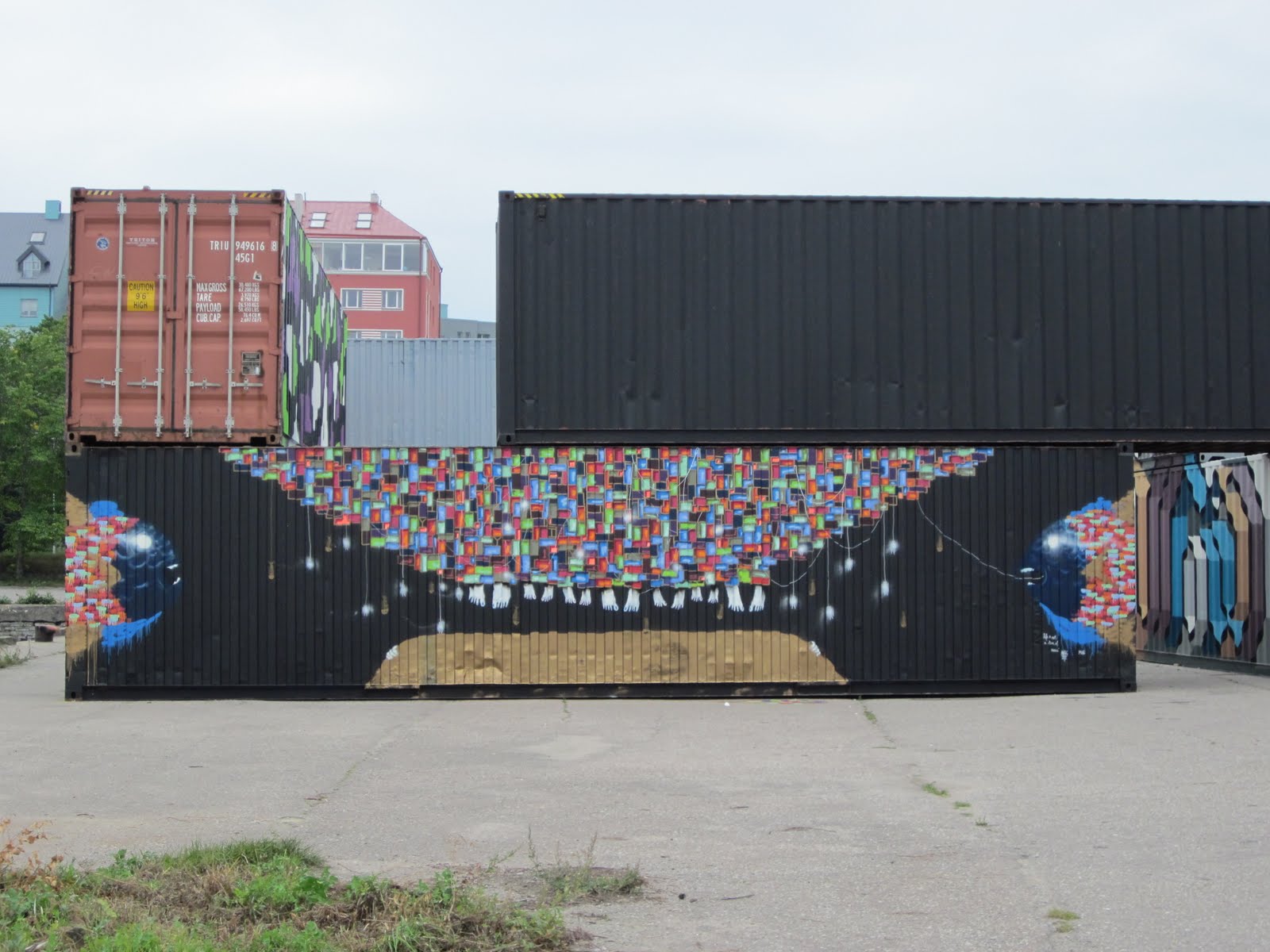
The area was interesting. Not a place many tourists go. In case you were wondering what the picture at the top was, check out this interesting art feature constructed of shipping containers that was down there. If you look to the right of the picture below, you can see part of the piece above.

After our walk, we went to the friend's house to meet her cats. Noostie liked them...it was not mutual. Her girl cats, to their credit, were brave. I never caught sight of one of the boys, and the other I saw only for a moment. Clearly they are not as into dogs as Noostie is into cats.

The rest of my weekend was spent figuring out (successfully!) how to use the washer and dryer and figuring out what was wrong with my computer (I had flipped the wireless off when pulling it in and out of my suitcase). And worrying about my wife and kitties, who were in the hurrican (they're fine...no damage...which those who know about our ceiling drama/trauma last year will understand how thankful I am for that!).

I can't even remember today what I did on Monday, except that I have been super busy. I did discover that the box I mailed myself before I left is now back in Virginia. Apparently they entered the zip in wrong at the UPS store, so my box took a tour of Amsterdam before heading home. I'm really disappointed. It had some decorations for my office, including pictures of my wife, nieces and nephews, plus some king sheets so I don't have to hunt through my HHE for sheets once my bed gets here.

I went to Tartu yesterday...the taxpayers got their money's worth yesterday! I went to work early because we have a staffdel in town (Congressional staffers) who I needed to brief, and I left after lunch for Tartu, about a 2.5 hour drive. We met with the Rector of the University of Tartu and then with our Fulbrighers (good group of folks we've got!). We got home about 9:30. So the taxpayers got 13.5 hours out of my for the 8 hours they paid for. On my "short" days, they only get 9.5 hours for their 8 hours.

Today was filled with meetings and with me trying (unsuccessfully) to register for a conference I have to attend. I did succeed finally in sitting down with my APAO so we could map out our responsibilities. He works really hard, and I would like to see him work a little less hard (don't worry taxpayers, you are getting your money's worht out of him and then some...he is a workhorse and a great officer. He is going to do really well in the service if I can keep him from burning himself out).

So slowly but surely, I am getting a handle on things. And I am really liking it. Even the putting out fires parts!

This is what I joined the service to do. One of the staffers came by my office (ours is the only bathroom near where they are meeting) and I asked how things were going. We ended up chatting for a minute about dogs and how she had been afraid to join the Foreign Service because she has a dog. I told her all about Noostie and how we travel together. And how you shouldn't give up all that makes you who you are, including your pets, because the point is to show the world the diversity of America by the diversity of those of us who serve overseas.

And she looked at me and said, "You're a Public Diplomacy Officer, aren't you?"

Yes I am.

Saturday, August 27, 2011

TGIF!

Clearly, I will spend a lot of the next three years in meetings.

My day basically starts out with a meeting, the press briefing. I come in at least an hour before it starts to try to prepare for it, basically searching the internet to see what has been said in the press about Estonia or us in the past day. We have someone on the local staff who does the same thing for the Estonian and Russian media here, and she does a fantastic job.

After the press briefing, I return to my office and try to sort through my email. I like organization, so I go through and sort and file what I can, direct others where they need to go and list who the action is currently with. This task is ongoing...you wouldn't believe the amount of stuff that comes in. There might be a draft of a speech or of a press release. There might be a grant request, or a meeting to arrange. Always there is the daily message and press summaries coming through. And of course, event planning.

I'll be going to one of those events later today. In conjunction with the Ice Cream Party, we are co-sponsoring a Soap Box Derby. Should be a lot of fun.

I managed to eat my lunch at a decent hour yesterday, and then had a meeting out at the Tallinn University of Technology. Some impressive folks there...Skype is out there. We talked about all sorts of visitors programs with them, as well at the Baltic American Freedom Foundation innovation award we are working on. Top prize is 10,000 euros, second is 5,000 euros. These are just the sorts of folks we'd love to see compete.

In the afternoon there were conference calls, more email sorting, and the like. I got home around six, in time to walk the dog before heading to dinner with a friend. We walked out to Kadriorg and ate at a little Thai place there. Not as good as my favorite Thai place in South Arlington, but still perfectly acceptable. It was a nice walk too...maybe 15 minutes.

Can I tell you how much I LOVE living in the city? Seriously, almost everything I need is in walking distance.

Except of course, the place my sponsor took me to today. Prisma. It is kind of like an Estonian Walmart. I was able to do some grocery shopping, plus buy a dust pan, trash can, and alarm clock! I could have also bought clothes, shoes, sporting goods, fishing equipment, towels and gardening supplies. But I don't actually need those things.

I leave shortly to go sailing. The weather for it is AMAZING! Sunny, in the 70s (the thermostat at a nearby bank said 31, which is about 87, but I am not sure I believe that.

They say the weather will change soon, so I am very glad to be enjoying it while I can!

Saturday, July 24, 2010

PD Does Not Stand For Pixie Dust

A quote I heard twice on Friday, attributed to Dan Sreebny, is that PD does not mean "pixie dust." You can't spinkle a little PD on a steaming mess and make it all better.

It seems a lot of non-Public Diplomacy folks tend to leave PD out of the picture until something bad happens, and then they hope PD can fix it. Part of this stems, no doubt, from the time before "integregration," when USIA was folded into the State Department. It seems it has been, and to a degree continues to be, an uncomfortable marriage.

I think this is a shame. I believe in Public Diplomacy as part of our overall diplomatic strategy. It is not just about "poster shows" and making people love us. Because people don't love or hate us because of a lack of exposure to America and Americans. They love or hate us (or both) because of our policies.

Which is why I believe, as does Under Secretary for Public Diplomacy Judith McHale, that Public Diplomacy HAS to have a seat at the policy table. We need to know before the catastrophy how an action we take is going to be received. We need to be able to aim all of our programming and messaging at meeting the strategic needs of the mission and of the Department. We can't do that if we concern ourselves only with culture and cleanup. We have to be pro-active.

Which is why I am glad she is creating DAS (Deputy Assistant Secretary) positions in each of the regional bureaus. So we have a PD voice at the policy table from the get go.

Because I am a diplomat. My job is representing the US and its policy overseas.

And I'd make a lousy pixie.

Wednesday, May 12, 2010

Overseas Posts: Central to Success in Public Diplomacy

My CDO sent this to me yesterday and I thought it might be of interest to those of you who are PD-coned or hoping to become PD officers.

Overseas Posts: Central to Success in Public Diplomacy
Vol. II Issue 5, May 2010
By William A. Rugh

Since 9/11 there has been a proliferation of writing about public diplomacy, but very rarely does any of it focus on what U.S. public diplomacy professionals actually do at diplomatic missions around the world. The many books, articles and studies have centered their attention almost entirely on the Washington end of the story. Why? Few Americans know anything about what a U.S. embassy does, or have ever been inside one. Our media does not report on embassy operations. Similarly, think tanks and organizations issued more than 30 reports on public diplomacy, consulting very few people who have lived and worked abroad, keeping it Washington-centric.(1) Even scholars tend to share that focus. (2) Thus, most of the literature leaves out an important half of the story.

Ignorance of what goes on at our embassies abroad leads to another misunderstanding, namely that most Americans have come to believe that public diplomacy is all about leadership in Washington. It is true that the election of President Obama has improved the American image abroad. (3) His speeches in Egypt and Ghana and town hall meetings in other countries present a sharp contrast to the style of President Bush, who did not seem much interested in foreign public opinion and preferred a unilateralist approach to the world. Public diplomacy practitioners know that listening carefully and engaging in a dialogue shows respect for others' opinions and concerns, as it helps shape our communications better. This is precisely why practitioners applaud President Obama's style of speaking not just to heads of state but taking the trouble to address ordinary citizens in foreign countries. Secretary of State Hillary Clinton also used town hall meetings abroad to good effect. Since becoming secretary of state she has travelled nearly 300,000 miles, visiting 54 countries. She has done public appearances on many of her trips, for example last February 15 when she was in Doha, Qatar she had a public exchange at a meeting with students at Carnegie Mellon University's Doha campus. Yet, a successful public diplomacy overall effort cannot be carried out only by a few senior people in Washington. Foreign commentators have begun to criticize the President's foreign policy pledges because they have not led to immediate solutions to the problems he addressed and that foreign audiences care about.(4) American officials must now cope with the expectations that the President raised. More importantly, concerns vary from one country to another, requiring different answers that can be best addressed by people on the ground who are well versed in local issues.

Many people do not realize that there is a considerable difference between what Washington does in public diplomacy and what field posts do. Officials in Washington decide global policies, but when Foreign Service Officers (FSOs) at field posts explain and support them in conversations with local audiences, they cannot simply repeat guidance fed to them by officials at the State Department in Washington and end it there. They must elaborate, within limits, bearing in mind local concerns and interests. In other words, they try to translate Washington's guidance into arguments and rationales that will resonate with the local population. This does not mean that the FSO will ignore policy guidance or go beyond it in a way that distorts it, but nobody will listen to him or her parrot only what a Washington official says.

An FSO must of course consider every public statement made by a senior official in Washington as official policy to be taken as guidance, but those statements are more often than not crafted with an American audience in mind, and consequently do not always address the concerns of a foreign audience. Moreover, the FSO is required to represent all of America, not just the administration in power, so the task is broader than policy advocacy.

Even the Under Secretary of State for Public Diplomacy and Public Affairs, whose job it is to supervise the U.S. government's communication with foreign publics, tends to see the world from a Washington perspective rather than a field perspective. For example, when Under Secretary Judith McHale testified before the Senate Foreign Relations Committee on March 10, 2010, she remarked that the Department of State must do a better job of "understanding the opinions and attitudes of foreign publics." While she is correct, her vision(5) consists of growing the federal bureaucracy and creating a new "market research" staff at the State Department. Public diplomacy professionals would argue that one of the most important tasks they face when working at an embassy abroad is trying hard to "understand the [local] opinions and attitudes." They usually spend most of their working day doing just that, following local media reporting and editorials for clues on local thinking, talking daily with their contacts and with local hires, and keeping their finger firmly on the local pulse. A public diplomacy effort can only succeed if the American and local staff at the U.S. embassy devote constant attention to the task of following local opinion.

A basic requirement for success in a public diplomacy effort in any country is that the PD practitioners must spend much of their time engaging personally with a wide variety of people in the local society. As President Kennedy's U.S. Information Agency director Edward R. Murrow famously said, it is "the last three feet" that count, meaning the most important link in any communication is personal face-to-face interaction. He was aware of that important truth even though he had been a professional broadcaster who communicated mostly by radio and television. Only through personal interaction can the PD professional really understand local concerns and views of America, and personal interaction is the best way to counter misunderstandings about the United States. This is crucial as Americans and foreign audiences usually see things differently. For example, President Bush's policy after 9/11 focused on counter-terrorism, the wars in Iraq and Afghanistan, and promoting democracy. Foreign audiences had other priorities. Bush was fond of saying that 9/11 "changed everything;" that may have been true for Americans, but it was not necessarily so to the rest of the world. Public diplomacy professionals with field experience also know that local conditions hugely influence the programs they carry out. In some countries we can use the full range of public diplomacy instruments, but in Afghanistan and Iraq the violence and poor security conditions severely limit what they can achieve. In highly wired societies like Japan and South Korea, public diplomacy professionals can use media such as satellite TV, and social networking sites like Facebook and Twitter. In some developing countries the public does not have similar access to such tools and many people do not even have a dependable access to electricity, so other means must be used. Judith McHale calls for the expanded use of new media, and most American commentators on public diplomacy concur with this approach, seeing how well this works in America; but it is a mistake to assume the same works everywhere.
The literature contains many inaccuracies about public diplomacy field operations. The reports mentioned above argue that public diplomacy should be the purview of the public sector. Jan Melissen, Professor of Diplomacy at Antwerp University in Belgium, wrote that non-state actors are "extremely agile and capable of mobilizing support at a speed that is daunting for rather more unwieldy foreign policy bureaucracies." (6) FSOs who have served abroad would dispute that description. They are keenly aware of the work of Americans representing companies and NGOs abroad, is simply not comparable at all with the work of an American official.

Kristin Lord, another scholar, posited in a report that American public diplomacy be reformed by creating a new non-governmental organization called "USA World Trust" that would do better than the government. The report stated this organization would, among other things, create exchange programs to bring foreign university professors, journalists, NGO representatives and government officials to the United States; it would send American experts abroad on speaking tours; it would understand foreign opinion through focus groups; and it would sponsor translations of American books into foreign languages. (7) Those are all worthwhile public diplomacy projects, but the problem with this report is that all of those activities are already carried out by American diplomats around the world. They have been standard tools in the official U.S. government effort for decades, a fact that this report fails to acknowledge.

If we want a successful public diplomacy effort, we need to devote more attention to the support and development of public diplomacy specialists in the Foreign Service, the so-called "PD cone." Sometimes FSOs from other cones, such as political or economic, are assigned to PD positions at embassies abroad, for purposes of their cross-training, but this practice has been carried too far and it has undermined the professionalism of our public diplomacy effort because FSOs with no experience in public diplomacy are given public diplomacy tasks. Diplomacy and public diplomacy are best learned on the job, and the best PD officers tend to be the officers who have had the most actual experience doing public diplomacy. Since the USIA-State merger in 1999, this specialization has been diluted by too much cross-training and that trend should be reversed.

Only a small number of people writing today have pointed out the central importance of field operations to public diplomacy. (8) It remains a badly neglected aspect of the subject. If we are to improve public diplomacy outreach, we should pay heed to our diplomats' work at embassies all over the world.

(1) Susan B. Epstein and Lisa Mages, "Public Diplomacy: A Review of Past recommendations", Washington DC: Congressional Research Service, October 31, 2005
(2) For example one excellent scholar has written a superb book on USIA that pays very little attention to field operations: Nicholas J. Cull, The Cold War and the United States information Agency, New York: Cambridge University Press, 2008)
(3) Pew Research Center, "Confidence in Obama Lifts U.S. Image Around the World", research report July 23, 2009, http://pewglobal.og/reports
(4) Testimony of Pew Research Center President Andrew Kohut before the House Committee on Foreign Affairs, March 4, 2010, http://www.pewtrusts.org/news_room_detail.aspx?id=57624
(5) http://foreign.senate.gov/testimony/2010/McHaleTestimony100310p.pdf
(6) Jan Melissen, "The New Public Diplomacy", in Jan Melissen, Ed, The New Public Diplomacy, New York: Palgrave Macmillan, 2007, p.24.
(7) Kristin Lord, "Voices of America: U.S. Public Diplomacy for the 21st Century, Washington DC: Brookings, November 2008, pp.18-23.
(8) For example Wiliam P. Kiehl, "The Case for Localized Public Diplomacy", in Nancy Snow and Philip M. Taylor, Eds. Routledge Handbook of Public Diplomacy, New York: Routledge 2009, pp.212-24, and Mike Canning, "The Overseas Post: The Forgotten Element of our Public Diplomacy", Washington DC: Public Diplomacy Council, 2008, www.publicdiplomacycouncil.org/uploads/canningoverseasposts

William A. Rugh is the Edward R. Murrow Visiting Professor of Public Diplomacy at the Fletcher School of Tufts University.

He was a United States Foreign Service Officer 1964-1995. He held positions abroad for the U.S. Information Agency in Cairo, Riyadh and Jeddah, and in Washington as Assistant Director of USIA for the Near East and South Asia. He also held presidential appointments as the United States ambassador to Yemen and ambassador to the United Arab Emirates, and a State Department appointment as Deputy Chief of Mission in Syria.

He was President and CEO of the educational NGO AMIDEAST 1995-2003, that manages educational programs in the Arab world.
He holds a PhD in international relations from Columbia University and an MA from the Johns Hopkins School of Advanced International Studies.

He taught U.S. Middle East Policy and Public Diplomacy at Fletcher 1984-86 and he has taught Public Diplomacy there since 2008.
He is the author of "American Encounters with Arabs: the Soft Power of U.S. Public Diplomacy in the Middle East" and other books and articles on public diplomacy. He has also published books, articles and opeds on American diplomacy, Arab media and US-Arab relations.

He is a member of the following boards of directors: AMIDEAST (executive committee), the American University in Cairo, the Middle East Policy Council (vice chair), the Public Diplomacy Council (executive committee), the Suffolk University International Advisory Board, and the Arab Media and Society Editorial Board.

He is married to Dr. Andrea Rugh, an author and consultant. He has three sons: David Rugh of Yorba Linda, CA, Nicholas Rugh of Menlo Park, CA, and Douglas Rugh of Pocassett MA. His winter home is in Garrett Park MD, and his summer home (June-October) is in Woods Hole, MA

Thursday, March 11, 2010

State Dept. plans new public diplomacy posts

This is in today's Washington Times and discusses the changes coming to Public Diplomacy as announced in Under Secretary McHale's strategic vision report.

State Dept. plans new public diplomacy posts

By Nicholas Kralev

The State Department plans to create seven new senior positions to ensure that a public-diplomacy perspective is always "incorporated" in policymaking around the world, as well as to respond quickly to negative coverage of the United States in foreign media.

In an ambitious strategy that goes beyond any previous efforts to reach out to other countries, the Obama administration "seeks to become woven into the fabric of the daily lives of people" there, its top public-diplomacy official said Wednesday.

"We must do a better job of listening, learn how people in other countries and cultures listen to us, understand their desires and aspirations, and provide them with information and services of value to them," said Judith A. McHale, undersecretary of state for public diplomacy and public affairs.

Ms. McHale presented the administration's strategy, which emerged from an eight-month review of the government's programs in the field, at a hearing of a Senate Foreign Relations subcommittee. She repeatedly used the word "narrative" to describe how the United States is being depicted overseas.

"In this information-saturated age, we must do a better job of framing our national narrative. We must become more proactive and less reactive," she said.
"Increasingly, our opponents and adversaries are developing sophisticated media strategies to spread disinformation and rumors, which ignite hatred and spur acts of terror and destruction. We must be ever-vigilant and respond rapidly to their attacks against us," she added.

To spearhead such an effort, the State Department will create a new position of deputy assistant secretary for international media support, who will report to the assistant secretary for public affairs, P.J. Crowley.

Six additional deputy assistant secretary positions will be added to each of the department's so-called regional bureaus, which cover Europe, Asia, South Asia, the Middle East, Africa and Latin America.

"These officers will be responsible for ensuring that a public-diplomacy perspective is incorporated as part of senior policy deliberations and for coordinating all our public-diplomacy initiatives throughout their respective regions," Ms. McHale said.

"We are taking steps to ensure that our policies and programs are informed upfront by a clear understanding of attitudes and opinions of foreign publics," she said.

Including public-diplomacy officials in policymaking was also a priority for Karen P. Hughes, undersecretary of state in the George W. Bush administration. She became a full participant in then-Secretary of State Condoleezza Rice's senior planning meetings, but a true integration of public diplomacy in the policy process has yet to be achieved.

The importance of such an integration across the government was cited by Mrs. Hughes and two other former undersecretaries, James K. Glassman and Evelyn S. Lieberman, during the same hearing of the Senate Foreign Relations subcommittee on international operations and organizations, human rights, democracy and global women's issues.

Mr. Glassman, who succeeded Mrs. Hughes at the end of the Bush administration, said that public diplomacy is "in doubt," because "it is not today being taken seriously as a tool of national security by policymakers."

Mrs. Lieberman, the first occupant of the undersecretary post when it was created at the end of the Clinton administration, said the State Department's "public-diplomacy practitioners are not considered equal" to other diplomats.

At the same time, both Mrs. Hughes and Mr. Glassman cautioned against an obsession with "being liked" by foreigners, which Mrs. Hughes called a "fundamental misunderstanding" of the purpose of public diplomacy.

"Today, in the war of ideas, our core task is not how to fix foreigners' perceptions of the United States, but how to isolate and reduce the threat of violent extremism," Mr. Glassman said.

Ms. McHale, a former CEO and president of Discovery Communications who took office in May, has kept a low profile compared with Mrs. Hughes' high visibility, which was mainly a result of her close personal relationship with Mr. Bush.

Edward P. Djerejian, a former career diplomat and founding director of Rice University's James A. Baker Institute for Public Policy, said there is no doubt that, in the current administration, President Obama is the nation's "top spokesman."

"They are using the president in a major way," said Mr. Djerejian, who headed a congressionally mandated commission on public diplomacy in 2003. "The undersecretary is a coordinator and a substantive manager to ensure the instruments of public diplomacy are used across the government."

Wednesday, September 09, 2009

Public Diplomacy Front Line Working Group

Mountain Runner has this today:

Public Diplomacy Front Line Working Group, WHITE PAPER, "Public Diplomacy: A View from the Front Line," June 8, 2009. In this online statement, ten mid-level U.S. Foreign Service Officers "with no institutional memory of the U.S. Information Agency," provide recommendations to their senior leadership on ways to empower, integrate, and equip "a new generation of public diplomacy officers." Their white paper values field cooperation with embassy political and economic officers, networks with partners in other governments and civil society, embedding public diplomacy officers in the State Department's regional bureaus and policy process, technological and media savvy, restoration of USIA's Junior Officer training program, mid-level expanded training, and graduate-level education opportunities in public diplomacy and related fields at civilian universities.

The group has a Facebook page outlining their recommendations. I know several of the members of the working group (to say nothing of the number of its "fans" that I know), and they are a solid bunch. That such a working group and white paper should originate with them comes as no surprise to me.

Thursday, August 20, 2009

Good thoughts for the Afghanis

The Afghan elections are going on today, and from the news reports, it seems like the violence is not as bad as it could have been. This is a great relief to me, not just for the Afghan people, but selfishly, because I have very good friends there. I want them to come home safely.

I'd also love to see an Afghanistan that resembled the one pre-Taliban, pre-Russian invasion. Where the numbers of women in Parliament exceeded that of our own Congress. Where people were passionately democratic and religiously tolerant. I know that Afghanistan is a long way off, but I wish it for them none the less.

An unrelated note: You might have noticed I am writing more instead of just pasting articles with a little comment. The reason is two-fold. First, I missed writing. But perhaps more importantly, I began my new assignment about a month ago. My last assignment was one were I couldn't talk about my work. While I LOVED that work and that bureau, I am now in a position where I can talk about what I do and I am not having to filter what I talk about based on what I have read because everything I read is unclassified. And most of it is either in the press or related to it.

Yay for being a Public Diplomacy Officer!

Saturday, August 08, 2009

Public Diplomacy Reserve Corps

An interesting article on public diplomacy at Understanding Government:

PUBLIC DIPLOMACY: MORE PEOPLE NEEDED TO DO MORE FOR AMERICA ABROAD

By Mitchell Polman

Washington, D.C. — Defining “public diplomacy” is almost a cottage industry among bloggers and others interested in the way America interacts with foreign states and audiences. The term "public diplomacy" was first coined by Dean Edmund Gullion of the Fletcher School of Law and Diplomacy at Tufts University in 1965. Gullion called it " . . . influencing the way groups and peoples in other countries think about foreign affairs, react to our policies, and affect the policies of their respective governments." Public diplomacy blogger Matt Armstrong has devoted thousands of words to this topic, including these: "The purpose of public diplomacy is to identify, empower, encourage (and possibly equip) self-organizing systems." Perhaps the most widely accepted definition today is the one offered by retired diplomat and public diplomacy expert Hans Tuch, in his book Communicating with the World: U.S. Public Diplomacy Overseas says public diplomacy is "a government process to communicate with foreign publics in an attempt to bring about understanding of its nation’s ideas and ideals, its institutions and culture as well as its national goals and current policies.”

While the definition may be debated, there is one aspect of America’s public diplomacy efforts that is not subject to much argument: the need for the department to recruit more people to work on it. Given the wide range of issues “PD” foreign service officers are responsible for – they serve as press and information officers, sign people up for government-sponsored exchange programs, conduct cultural programs, promote English language education, and oversee American libraries and other cultural resource centers, among other things – it’s no surprise that, given the State Department’s overall Foreign Service staffing problems, the public diplomacy area is also feeling squeezed.

To address this problem, the State Department needs both to revamp its traditional hiring procedures and to look at some innovative approaches.

When candidates for the department’s Foreign Service register take the entrance examination, they select the area of expertise they wish to build their careers in from five "cones," including administrative, consular, economic, political, and public diplomacy. The staffing shortage mentioned above is particularly acute in the public diplomacy cone. The U.S. Advisory Commission on Public Diplomacy in 2008 published a report called "Getting the People Part Right," which states that as of 2007, public diplomacy had the second fewest number of officers of among Foreign Service cones.

The shortage is seriously hampering the State Department’s public diplomacy mission because most public diplomacy work is currently being carried out by junior level officers who are stretched too thin. As a recent Government Accountability Office (GAO) report, entitled U.S. Public Diplomacy: Key Issues for Congressional Oversight, asserts, the State Department is facing a shortage of mid-level public diplomacy officers that will take years to erase. Even more significantly, the GAO notes that this lack of public diplomacy personnel is preventing the State Department from effectively spending the funds Congress has allotted specifically for public diplomacy. So the nation’s ability to communicate and interact with foreign publics is clearly hampered by the lack of personnel.

Of course, this is about more than just the number of public diplomacy personnel. The State Department also needs people with the right mix of skills. Some public diplomacy officers, for example, have strong media relations skills, but lack foreign language training. Others may have strong language skills, but little in the way of media outreach experience.

State Department Tests a Better Test

Gaps like these were one of the reasons that the Foreign Service in 2007 moved towards a "total candidate approach" in its examination process. The new Foreign Service examination places a greater emphasis on actual work experience. For example, the newly revised Foreign Service Oral Exam includes a "Qualification Evaluation Panel" (QEP) that factors the actual real world experience of a candidate into the exam score. Consequently, a candidate for the public diplomacy cone who has media or cultural exchange experience, for example, gets a higher score because of that experience. This has made it easier for the Foreign Service to identify and recruit candidates who would make suitable Public Diplomacy officers. The Advisory Commission reports that public diplomacy is now the second most popular cone choice of those taking the oral exams (political being most popular).

There is, however, still room for improvement in the examination process. David Firestein, a career foreign service officer, is also Deputy Executive Director of the U.S. Advisory Commission on Public Diplomacy. Firestein believes that the QEP has been instrumental in helping the department identify suitable candidates for public diplomacy work. However, he comments that "…even today the public diplomacy knowledge does not come through on this exam to the degree that it probably should" and adds that those designing the foreign service exam “ . . . haven’t yet built . . . a public diplomacy exercise” into the test. Finally, Firestein notes that State is “not recruiting specifically for PD expertise or testing for it either." Thus, the advisory commission report recommended that State test candidates for specific public diplomacy skills and criticized the department for not actively promoting Public Diplomacy Officers to senior level positions within the department.

Congress has been listening closely to the Advisory Commission on this issue. The FY2010 appropriations bill for the Department of State (H.R. 2410) contains most of the commission’s proposals for strengthening U.S. public diplomacy. Amongst those proposals is a long standing recommendation to create a Public Diplomacy Reserve Corps (PDRC) that would recruit Foreign Service retirees and others with public diplomacy experience to fill public diplomacy related vacancies at the State Department. The act specifically states: "The Secretary of State is authorized to establish in the Foreign Service a Public Diplomacy Reserve Corps consisting of mid- and senior-level former Foreign Service officers and other individuals with experience in the private or public sector relevant to public diplomacy, to serve for a period of six months to two years in postings abroad."

But would a PDRC make it difficult for more junior level public diplomacy officers to move up in the ranks? Firestein calls that "a fair question" and says that it’s a concern that "…deserves attention and a longer term strategy." But given that the House resolution on DOS funding specifically mentions “other individuals with experience in the private or public sector relevant to public diplomacy,” it is time for creative solutions.

A Good Time for Change and Innovation

Some suggest that the best use of a reserve corps would be at home, rather than abroad. William P. Kiehl, a former Foreign Service Officer and public diplomacy specialist, commented that the best use of a public diplomacy reservist might be as a "… desk officer in Washington for an area that he or she knows well and has served in multiple times.” Kiehl said this kind of reinforcement at Foggy Bottom would help ensure a higher degree of “background in the country and culture of the region currently lacking as most Country Affairs Officers currently have little or no expertise in either the region/country or in public diplomacy." But given the language problems the Foreign Service still faces – the May 2009 GAO report said that fully 25% of officers designated for public diplomacy positions did not meet the language requirements – sending experts abroad to help may be more important. Retired Foreign Service Officer and public diplomacy blogger John Brown said he feels the proposed PDRC makes a lot of sense, "especially if the chosen officers are sent to countries where they would be able to speak the local language."

This is an ideal time not just for revamping public diplomacy, but for exploring fresh approaches to staffing this area of the State Department’s portfolio. It looks like the growing focus on public diplomacy – after several rocky years in the Bush administration, especially early on, when public diplomacy was not in favor – is dovetailing with the Foreign Service’s own personnel requirements. The State Department might consider developing the PDRC not just as a way for retirees and public diplomacy professionals to pitch in, but as a channel for both younger people and mid-career professionals from outside the department who are interested in public diplomacy careers. The number of Foreign Service candidates expressing an interest in public diplomacy is on the rise, but until now the State Department has not even had enough staff on hand to expend all the funds allotted for public diplomacy.

The PDRC could serve as an ideal training program for candidates awaiting background checks, recent graduates, and people considering a career in public diplomacy, including mid-career professionals who may be interested in a State Department career. These might be public diplomacy fellows, or trainees, who would be drawn from outside the Foreign Service and might then go on to enter the service itself as career officers. If these people brought in media and public relations skills fundamental to public diplomacy, the State Department would benefit and its public diplomacy efforts would be more effective. As it is currently, the State Department hires many independent contractors to perform work on its public diplomacy programs. A number of those positions could be filled by PDRC members.

The Public Diplomacy Reserve Corps appears to be a step in the right direction, but it could also be used as a recruiting tool for the department, as well as a way to fill gaps in personnel. The political stars are aligned in such a way as to make bold changes on the public diplomacy front possible. The State Department has the support of the new administration and Congress to come up with creative solutions to longstanding and very persistent problems – just at the time when the world is opening up to a new image and understanding of America.

Friday, July 24, 2009

State's Job

Politico has an article on the House gutting DOD’s IO budget. Here's why they are slashing it:

"It’s propaganda. Why, the military’s got nothing to do with this. That should be in the State Department, in my estimation." Rep. John Murtha (D-Pa.)

You can read the entire article here.

This is even funnier to me now that I am in Public Affairs (yes, I made it to the mother bureau at last!).

Wednesday, April 01, 2009

Mountainrunner: Isolated Overseas: Diplomatic Security Creates Challenges for American Public Diplomacy

Mountainrunner's guest blogger Mitchell Polman wrote a piece yesterday on challenges for Public Diplomacy:

Isolated Overseas: Diplomatic Security Creates Challenges for American Public Diplomacy

When Congress voted to abolish the U.S. Information Agency (USIA) in 1999, America's public image abroad suffered a significant blow. This decision - inspired by the desire to shrink government and the predominant belief that USIA was an ineffective bureaucracy - closed many USIA-run American libraries and cultural centers around the world that were helping to promote better understanding of American culture and society. These gathering places - located in embassy buildings or in libraries and cultural buildings of host countries - were an important tool for U.S. public diplomacy. They organized English language classes, discussions about American society and politics, films, and other cultural events. Local residents had safe and accessible places to read American books and periodicals, find out about educational exchanges, take U.S. college entrance and language exams, and interact with American citizens.

But beyond the loss of a special department devoted to public diplomacy, America's international image and outreach have been hurt by changes in diplomatic security standards following embassy bombings in the 1990s and the tragic events of September 11. New security requirements, designed to keep our diplomats and their families safe, often put American cultural resources out of sight and out of reach for foreign citizens with a healthy interest in American affairs. As a result, we are losing what legendary journalist and one-time USIA director Edward R. Murrow called "the last three feet" in our country's "communication chain."


You can read the entire piece here.

Monday, March 09, 2009

WP: Crowley may be next Department Spokesman

Al Kamen had this snippet in today's In the Loop:

DRAFTING COL. CROWLEY

There's buzz that the administration is looking to bring Philip J. Crowley, senior director for public affairs for the Clinton National Security Council and before that principal deputy assistant secretary of defense for public affairs, back into government to be top spokesman for the State Department.

Crowley, a senior fellow at the Center for American Progress, was a spokesman for the government and the military for 28 years, including 11 at the Pentagon and three at the White House. He served in the Air Force for 26 years, retiring as a colonel.


Wednesday, December 31, 2008

ST: Sizing Up Diplomacy

This illustrative piece from the Seattle Times was sent out by AFSA, our employee organization. I wonder how many people outside the Foreign Service got the correct answer.

Sizing up U.S. diplomacy
How many diplomats does the U.S. government have in active service?

Throughout the 2008 U.S. presidential campaign, President-elect Obama talked forcefully about the need to repair frayed relations with allies. To make it all happen, the new administration must rely on its diplomats. How many diplomats does the U.S. government have in active service?

A. 57,000

B. 12,000

C. 6,400

D. 4,700

How many diplomats does the U.S. government have in active service?

A. 57,000 is not correct.

The State Department employs roughly 57,000 people. However, 31,000 are foreign nationals working overseas as support staff in U.S. embassies and consulates. The United States maintains diplomatic relations with nearly 180 of 191 countries, as well as with several international organizations. Altogether, the State Department maintains nearly 265 diplomatic and consular posts.

B. 12,000 is not correct.

The State Department employs approximately 12,000 Foreign Service personnel. This number includes foreign-service officers as well as support staff and diplomatic security agents, a significant number of whom are stationed in the United States. Throughout much of the 1990s, overseas diplomatic staffing was significantly reduced, as the United States cashed in on the "peace dividend" brought about by the end of the Cold War. Although this trend began to reverse itself by 1997, the American Academy of Diplomacy estimates that the State Department faces a personnel shortfall of more than 2,000 staff-years relating to enduring core diplomatic work, emerging policy challenges and critical training needs.

C. 6,400 is correct.

Among all State Department employees, 6,400 — or 11 percent — are diplomats, meaning they are engaged in government-to-government diplomacy and represent U.S. interests and advocate U.S. policy positions abroad.

Coincidentally, this number is roughly equal to the personnel stationed aboard a typical U.S. aircraft-carrier battle group, such as the USS Enterprise.

D. 4,700 is not correct.

The American Academy of Diplomacy estimates that the State Department and the U.S. Agency for International Development will need to increase their ranks by 4,700 employees between 2010 and 2014 in order to carry out U.S. diplomatic initiatives successfully. For instance, the public diplomacy staff, which seeks to influence foreign publics by promoting U.S. policies, culture, society and values, is 24 percent smaller than in 1986.


And speaking of increasing the size of the Foreign Service, here is a comment from the blog Enough:

A good article in the January/February edition of Foreign Affairs by former President of the American Foreign Service Association J. Anthony Holmes advocates dramatically increasing the number of Foreign Service Officers (FSOs). Holmes offers some powerful statistics:

The number of lawyers at the Defense Department is larger than the entire U.S. diplomatic corps, there are more musicians in the military bands than there are U.S. diplomats, and the Defense Department’s 2008 budget was over 24 times as large as the combined budgets of the State Department and USAID ($750 billion compared with $31 billion).

Enough made similar calls for reform in a recent report, which noted that that in order to more effectively prevent conflict and mass atrocities, the U.S. Government must address the critical “mismatch between resources and requirements” at the State Department - sentiments which were echoed by former U.S. Ambassador for counter-narcotics in Afghanistan Thomas Schweich in the Washington Post
.

Wednesday, December 03, 2008

Mission for the national security team: rebuild America's 'soft power'

There are a couple of pieces today on rebuilding America's "soft power." From the Philadelphia Inquirer:

Worldview: The focus is on 'soft power'
Obama's new security team must first rebuild America's diplomatic machine.

[...]

Gates and Jones want to bolster our capacity to project "soft power" - diplomacy, and foreign aid for development and reconstruction. They view soft power as an essential complement to hard, military power, and as a way to prevent future conflicts.

Secretary of State-designate Hillary Clinton supports this shift, though she sought to project a tough-guy image in the presidential race. It will fall to her to implement one of the hardest parts of the new strategy - rebuilding a State Department so depleted that it can't do what needs to be done.

For years, the Bush administration derided soft power as "social work" - no substitute for the tough work of war-making. Its attitudes shifted as Afghanistan and Iraq fell apart following U.S. military actions. But the United States lacked the civilian skills to help those nations recover.

This forced the military to take on nation-building tasks for which it wasn't trained.

Meantime, Gen. David Petraeus' new emphasis on counterinsurgency doctrine stressed that such fights could not be won through military means alone, but also require political and economic components.

[...]

"What is not ... well-known," Gates said in a 2007 lecture at Kansas State University, "was the gutting of America's ability to engage, assist and communicate with other parts of the world - the 'soft power' which was so important during the Cold War."

For example, the United States has more members of military marching bands than Foreign Service officers. Gates also noted that the number of Foreign Service officers was frozen as the number of embassies grew after the Soviet Union breakup. Meantime, "the United States Agency for International Development saw deep staff cuts ... and the U.S. Information Agency was abolished."

[...]

The extent of the problem was described graphically in a report on the crisis in diplomatic readiness recently released by the American Academy of Diplomacy and the Stimson Center (available at www.academyofdiplomacy.org). The report details the shortage of Foreign Service officers, and particularly of those with training in critical languages such as Arabic, Chinese, Hindi and Urdu.

At a time when America's need to engage with the world has never been greater, funding for public diplomacy has been shrinking. USIA libraries and cultural centers, where young Arabs once could interact with Americans, have long been shuttered. While terrorists set up Web chat rooms, we have no capacity to interact with a global generation that uses the Internet.

"We are not staffed to keep up with old needs, let alone new needs," said Ronald Neumann, president of the American Academy of Diplomacy. He calls for more staffing for public diplomacy, new Web outreach, reopened cultural centers, and more exchanges.

[...]

It won't be easy to rebuild - and fund - soft-power agencies at a time when Obama is beset by crises. We don't know whether Clinton has the needed management skills. Obama's team will have to work together closely to give him the soft-power tools he seeks.


You can read the entire piece here.

And from Politics and Soccer:

Everyone wants a larger State Dept
[...]

But what is even better news is that Clinton, Gen. Jones (the national security adviser), and Gates at the Pentagon all signed on to Obama's core idea of shifting resources away from the Pentagon and towards the State Dept. This is a great idea and people have been screaming about it for years. [...] While the Pentagon's budget is over $500 billion and including the wars and future medical costs may rise over $1 trillion (and some idiots want to pin it to 4% of GDP), the State Dept had a measly $10 billion for FY 2008.

Despite almost universal agreement that the State Department is under-resourced, Pentagon budgets have continued to outpace State budgets in growth because of lots of Congressional pork. Probably the largest pork item is the United States Air Force. OK, that was an exaggeration, but stuff like the F-22 which is projected to cost at least $62 billion is equal to the State Dept budget for six years, and this is for an aircraft with no actual mission other than to defeat imaginary Chinese planes. Unfortunately for the State Department, it's budget doesn't create jobs in Congressional districts because they invest in people rather than buying stuff, so Congress doesn't throw $5 billion (half the State Dept's budget) at the State Dept in unwanted pork projects like they do the Pentagon.

[...]


You can read P&S's entire piece here.

Friday, September 26, 2008

More on Reforming Public Diplomacy

Diplopundit comments on the testimony by Ambassador Elizabeth Bagley, the Vice Chairman of the U.S. Advisory Commission on Public Diplomacy to the Senate Committee on Homeland Security and Government Affairs. This is the testimony Mountain Runner discussed earlier in the week. Diplopundit offers some more details and some interesting points.

Reliance on Soft Power: Reforming Public Diplomacy

Earlier this week, Ambassador Elizabeth Bagley, the Vice Chairman of the U.S. Advisory Commission on Public Diplomacy gave a testimony before the Senate Committee on Homeland Security and Government Affairs’ (Subcommittee on Oversight of Government Management, the Federal Workforce, and the District of Columbia) on Reliance on Soft Power: Reforming the Public Diplomacy Bureaucracy.

This is part of what she said in her opening statement: [...]“...in the final analysis, people are the key to the success of our Nation’s public diplomacy. Over a one-year period, the Commission met with scores of State Department officials and outside experts on PD human resources issues and we learned a great deal in the process.

In sum […], we found that the State Department:

recruits smart people, but not necessarily the right people, for the PD career track,
tests candidates on the wrong knowledge sets,
trains its officers in the wrong skills, and
evaluates those officers mostly on the wrong tasks.

In terms of personnel structures:

State has a PD bureaucracy in Washington that hasn’t been critically examined since the 1999 merger and that may or may not be functioning optimally, its overseas public affairs officers are spending the majority of their time administering rather than communicating with foreign publics, and meaningful integration of public diplomacy into State Department decision-making and staffing remains elusive.

In short, Mr. Chairman, we’re not “getting the people part right.”

[...]


"On recruitment, very simply, the Department of State makes no special effort to recruit individuals into the public diplomacy (or “PD”) career track who would bring into the Foreign Service experience or skills specifically relevant to the work of communicating with and influencing foreign publics. No serious presidential or Congressional campaign, or private-sector company, would hire communications personnel who have no background in communications, but to a large degree, that is exactly what the United States Government is doing."


Diplopundit notes: In fairness to the State Department, the agency makes no special effort to recruit folks into the PD track or any other track based on experience or skills relevant to the work in the other four career tracks (political, economics, management, consular). I do think that State prides itself with growing its own people which has its merits. But whereas in the past we have the luxury of time to grow and teach new graduates on how the world works, in this new universe of constant change, we don’t have that luxury. Why spend two years training an Arabic speaker, if you can hire somebody who already speaks Arabic, or Chinese, or Urdu?

[...]


Bagley continues: "In terms of public diplomacy training, though there have clearly been some improvements in recent years, a number of conspicuous, and serious, blind-spots persist. For one, we make virtually no effort to train our PD officers in either the science of persuasive communication or the nuts and bolts of how to craft and run sophisticated message campaigns. The Commission believes we need to rectify this. We would like to see more substantive PD offerings at the State Department’s Foreign Service Institute, including a rigorous nine-month course analogous to the highly regarded one currently offered to economic officers."

Diplopundit comments: We have some missions where entry level officers on their first tour are sent out to perform public outreach in print/online media, tv, and radio with close to no training. Well, actually as I’ve heard it told, one boss saw it fit to work with the PD officer to give one batch of officers some training, including apparently “murder boards,” but after that outreach program received an award, the next batch of officers got zero guidance (short term goals are terribly popular in some parts of this universe) but the public outreach nonetheless continued. I can understand why an officer, even a smart one who’s never been on television would lose sleep and sweat bullets over this one. Public diplomacy is not the area where you want to throw your staff members into the water to see who sinks or floats! Good grief! If we don’t send a soldier to war without training them how to shoot, we definitely should not send any of our officers to fight the war of ideas without "weapons" training. In a war zone, bullets are fired and spent and you die, in this other war, ideas, even the unkind ones have the tendency to live on and thrive. Seriously, if our officers have to be effective warriors of ideas, we cannot afford to let them simply wing it -- no matter how smart they may be.

[...]

You can read the rest of this post here.

In a comment I wrote to Mountain Runner on this topic, I noted that even in the instances where they have people with a background conducive to Public Diplomacy work, the Department often does not take note. I am a PD-coned officer. I have a B.A. in English/Journalism, and I have worked as a reporter and copy editor for several dailies. I have been an assignments editor for an NBC-affiliate. I also have an M.A. in anthropology and will soon have a PhD in it. All of these things should make me a better PD officer. However, I have yet to do a PD tour, and when I am in the midst of bidding (as I am now), prospective supervisors don't even consider my experience pre-State Department. A three-month "bridge" assignment I did as a press officer "counts" for more than all of my education and experience. A shame when you consider just how important Public Diplomacy is in today's world and how much a partner it could be in advancing our Foreign Policy goals if used properly by the right people.

Wednesday, September 24, 2008

Public Diplomacy and the Resource Shortage at State

Mountain Runner had an interesting piece today about a hearing of the Senate Homeland Security and Governmental Affairs Committee.

Mountain Runner writes: GovExec.com’s Kellie Lunney reports below on a hearing of the Senate Homeland Security and Governmental Affairs Committee, Subcommittee on Oversight of Government Management, The Federal Workforce and the District of Columbia. The hearing was spurred by the U.S. Advisory Commission on Public Diplomacy report earlier this year. Dirksen room 342 must have been a fun place to be (not).

"On the public diplomacy side, there is some positive news, but it's a grim picture overall," Amb. Scott DeLisi, director of career development and assignments in State's Bureau of Human Resources, said before a Senate Homeland Security and Governmental Affairs subcommittee. ...

The Foreign Service overall is short at least 1,000 officers "just to fill the jobs we have," DeLisi said. DeLisi, who spent most of his career in the field and assumed his current post just a year ago, called the situation "frightening." Even with those slots filled, many officers are not getting the training they need to be successful overseas, he noted, adding that the agency also would benefit from the creation of additional positions. "We need more [officers] in China, India, parts of Africa, the Middle East and parts of Indonesia," he said.

There’s more to this, of course, but it’s good to get more attention on the huge lack of resources for State. Tell me, where’s the senior leadership hammering Congress to actually commit itself to both allocating money and resources to State? Secretary Gates does not count. State’s leadership, with Congressional support, must push for not just more $$ for hiring FSO’s, but programming flexibility, hiring FSN’s, a training float (hear about this? seeking details), etc.


The piece he asks if you have heard about is this, from Abu Muqawama:

...one deep bit of inside baseball from the world of professional-military education (affectionately known as PME) is the difficulty in recruiting foreign services officers as students in the intermediate courses (like CGSC or its Marine equivalent at Quantico). While these schools are geared toward military officers, there is a noticable interagency presence as well. FSO's, however, are more commonly found only at the "top-level schools" like the National War College). Now, astute readers of this blog will know that's because State is miserably under-staffed. (Insert military band comparison here.)

So, LTG Caldwell has once again put his money where his mouth is: he's offered to cough up one officer for each FSO the State Dept. sends to CGSC. (Charlie's guessing these officers take up slack at Main State, not in the Embassies, but she's willing to be corrected on this score.) This is exactly the kind of wealth transfer Secretary Gates has been calling for: using the vast resources of DoD to enable more flexibility at State.